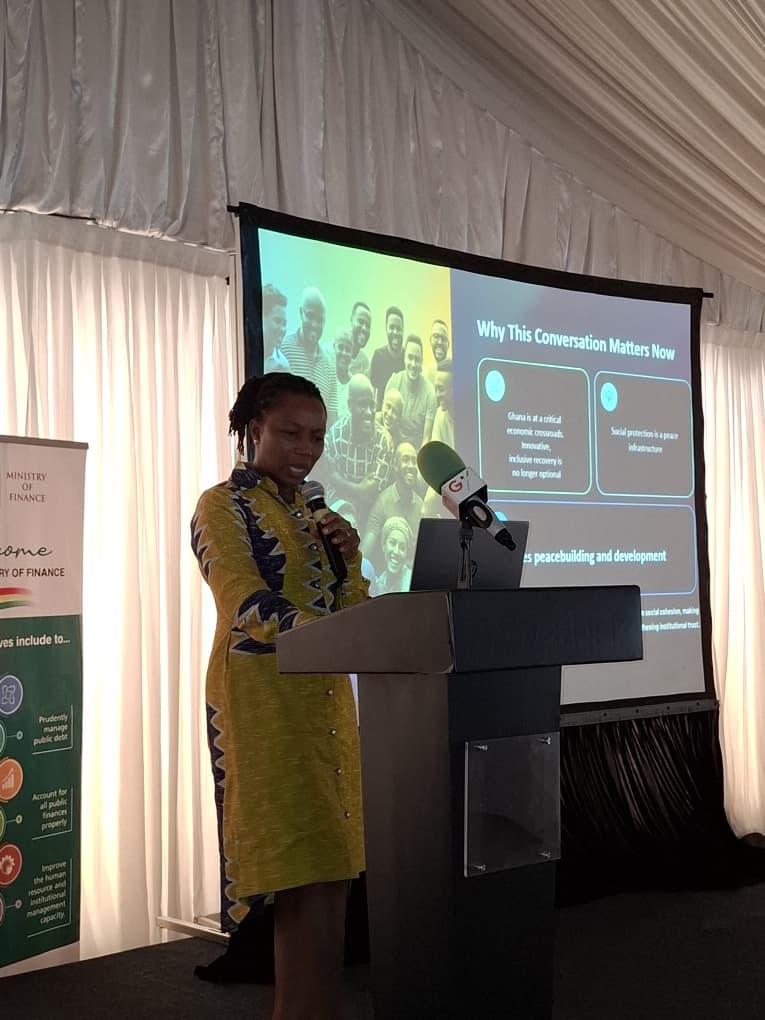
The Foundation for Security and Development in Africa (FOSDA) participated in the High-Level Social Protection Forum hosted by the Ministry of Finance (MoF), in partnership with the United Nations Economic Commission for Africa (UNECA), from 15–16 December 2025 in Accra. FOSDA’s intervention focused on integrating Women, Peace, and Security (WPS) into national social protection systems, emphasizing the role of social protection not only as a welfare tool but as a strategic investment in peace, stability, and resilience.
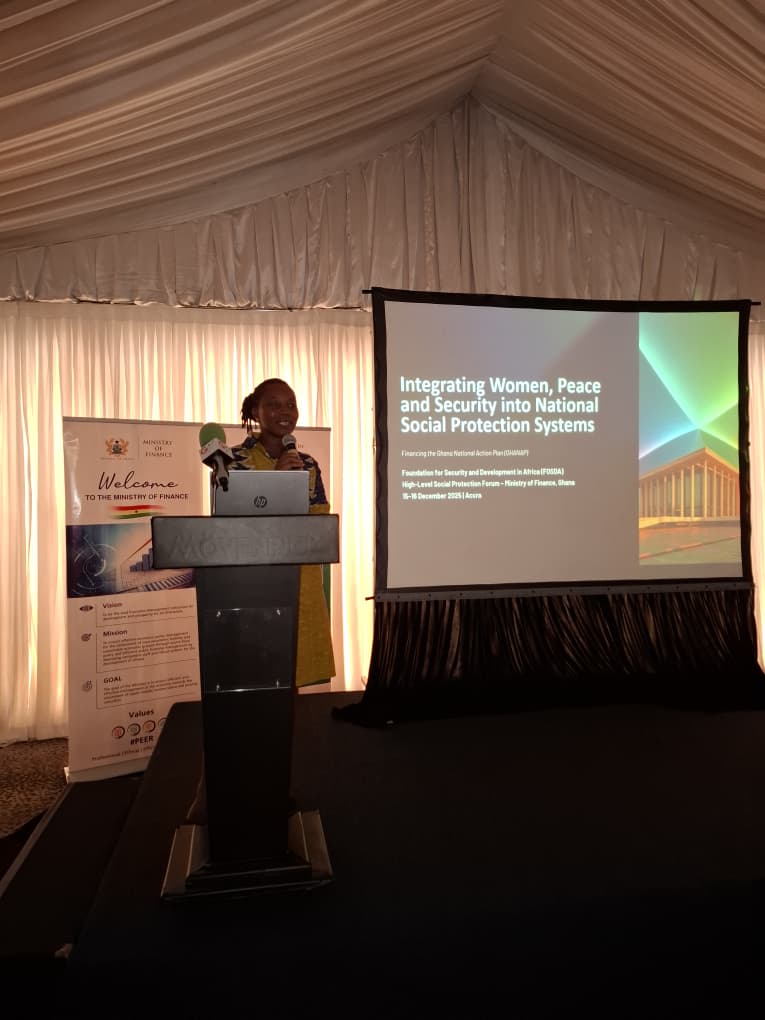
Positioning Social Protection as Peace Infrastructure
Presenting to policymakers and stakeholders, FOSDA – represented by its Executive Director, Mrs. Theodora Williams-Anti, and WPS Project Coordinator, Ms. Dorothy Barnes – highlighted that Ghana is at a critical reform moment where exclusion, economic shocks, and insecurity threaten social cohesion. They emphasized that applying a WPS lens strengthens social protection systems’ ability to prevent conflict, protect vulnerable populations, and support inclusive recovery. Drawing on the four pillars of the WPS agenda, FOSDA demonstrated how existing social protection interventions such as cash transfers, livelihood support, GBV response services, health insurance, and shock-responsive safety nets already operationalize WPS principles. The key challenge, noted though, lies in ensuring intentional integration, effective coordination, and sustainable financing.
The GHANAP Financing Imperative
Central to FOSDA’s advocacy at the Forum was a call for dedicated financing of the Ghana National Action Plan (GHANAP) on UNSCR 1325, positioning GHANAP as a core social protection and development investment rather than a stand-alone security initiative. FOSDA presented evidence showing that GHANAP implementation requires only 0.02% of GDP and 0.12% of the national budget. The FOSDA Monitoring GHANAP 2 exercise indicates that, despite chronic underfunding, approximately 60% of planned activities have been implemented, demonstrating strong institutional capacity and readiness to scale with adequate financing. Adequate funding, FOSDA emphasized, would deliver significant value for money by reducing long-term costs of conflict, gender-based violence, humanitarian response, and economic disruption. Financing GHANAP also aligns directly with Ghana’s Gender-Responsive Budgeting frameworks and national efforts to build inclusive, shock-responsive social protection systems.
Centering Women as Agents of Resilience
Another key message from FOSDA’s presentation was that women are not merely beneficiaries of social protection programmes, but central drivers of household and community resilience. Drawing on its peacebuilding and community security work, FOSDA highlighted that women often absorb economic and social shocks through unpaid care work, livelihood diversification, and community mobilization – critical stabilizing roles that remain largely unrecognized in policy design. Women are overrepresented among the poorest populations, disproportionately concentrated in the informal economy, and more exposed to the impacts of conflict, displacement, and economic volatility. Without deliberate integration of the WPS agenda, social protection systems risk overlooking those most vulnerable to insecurity and violence, including widows, survivors of gender-based violence, and women in fragile or border communities.
Key Policy Recommendations and Call to Action
At the conclusion of the presentation, FOSDA proposed actionable recommendations, including establishing a dedicated budget line for GHANAP within the 2026–2029 Medium-Term Expenditure Framework, integrating GHANAP financing into Ghana’s social protection financing basket, strengthening coordination among the Ministry of Finance, Ministry of Gender, peace and security institutions, and local government, and formally recognizing women peace actors and civil society organizations as implementation and monitoring partners in social protection delivery. FOSDA concluded by emphasizing that, amid growing donor uncertainty, Ghana has a clear opportunity to demonstrate domestic leadership on the WPS agenda. Financing GHANAP, the organization noted, is a strategic investment in social protection, peace, and long-term economic resilience, essential to ensuring that WPS commitments translate into measurable outcomes for women and communities.
%20participated%20in%20the%20High-Level%20Social%20Protection%20Forum%20hosted%20by%20the%20Ministry%20of%20Finance%20(MoF),%20in%20partnership%20with%20the%20United%20Nations%20Economic%20Commission%20for%20Africa%20(UNECA),%20from%2015–16%20December%202025%20in%20Accra.%20FOSDA’s%20intervention%20focused%20on%20integrating%20Women,%20Peace,%20and%20Security%20(WPS)%20into%20national%20social%20protection%20systems,%20emphasizing%20the%20role%20of%20social%20protection%20not%20only%20as%20a%20welfare%20tool%20but%20as%20a%20strategic%20investment%20in%20peace,%20stability,%20and%20resilience./p!--%20/wp:paragraph%20--!--%20wp:image%20id:11220,sizeSlug:full,linkDestination:none%20--figure%20class=wp-block-image%20size-fullimg%20src=https://fosda.org/wp-content/uploads/2026/02/WhatsApp-Image-2026-01-27-at-12.23.44-PM.jpeg%20alt=%20class=wp-image-11220//figure!--%20/wp:image%20--!--%20wp:paragraph%20--pstrongemPositioning%20Social%20Protection%20as%20Peace%20Infrastructure/em/strong/p!--%20/wp:paragraph%20--!--%20wp:paragraph%20--pPresenting%20to%20policymakers%20and%20stakeholders,%20FOSDA%20–%20represented%20by%20its%20Executive%20Director,%20Mrs.%20Theodora%20Williams-Anti,%20and%20WPS%20Project%20Coordinator,%20Ms.%20Dorothy%20Barnes%20–%20highlighted%20that%20Ghana%20is%20at%20a%20critical%20reform%20moment%20where%20exclusion,%20economic%20shocks,%20and%20insecurity%20threaten%20social%20cohesion.%20They%20emphasized%20that%20applying%20a%20WPS%20lens%20strengthens%20social%20protection%20systems’%20ability%20to%20prevent%20conflict,%20protect%20vulnerable%20populations,%20and%20support%20inclusive%20recovery.%20Drawing%20on%20the%20four%20pillars%20of%20the%20WPS%20agenda,%20FOSDA%20demonstrated%20how%20existing%20social%20protection%20interventions%20such%20as%20cash%20transfers,%20livelihood%20support,%20GBV%20response%20services,%20health%20insurance,%20and%20shock-responsive%20safety%20nets%20already%20operationalize%20WPS%20principles.%20The%20key%20challenge,%20noted%20though,%20lies%20in%20ensuring%20intentional%20integration,%20effective%20coordination,%20and%20sustainable%20financing./p!--%20/wp:paragraph%20--!--%20wp:paragraph%20--pstrongemThe%20GHANAP%20Financing%20Imperative/em/strong/p!--%20/wp:paragraph%20--!--%20wp:paragraph%20--pCentral%20to%20FOSDA’s%20advocacy%20at%20the%20Forum%20was%20a%20call%20for%20dedicated%20financing%20of%20the%20Ghana%20National%20Action%20Plan%20(GHANAP)%20on%20UNSCR%201325,%20positioning%20GHANAP%20as%20a%20core%20social%20protection%20and%20development%20investment%20rather%20than%20a%20stand-alone%20security%20initiative.%20FOSDA%20presented%20evidence%20showing%20that%20GHANAP%20implementation%20requires%20only%200.02%%20of%20GDP%20and%200.12%%20of%20the%20national%20budget.%20The%20FOSDA%20Monitoring%20GHANAP%202%20exercise%20indicates%20that,%20despite%20chronic%20underfunding,%20approximately%2060%%20of%20planned%20activities%20have%20been%20implemented,%20demonstrating%20strong%20institutional%20capacity%20and%20readiness%20to%20scale%20with%20adequate%20financing.%20Adequate%20funding,%20FOSDA%20emphasized,%20would%20deliver%20significant%20value%20for%20money%20by%20reducing%20long-term%20costs%20of%20conflict,%20gender-based%20violence,%20humanitarian%20response,%20and%20economic%20disruption.%20Financing%20GHANAP%20also%20aligns%20directly%20with%20Ghana’s%20Gender-Responsive%20Budgeting%20frameworks%20and%20national%20efforts%20to%20build%20inclusive,%20shock-responsive%20social%20protection%20systems./p!--%20/wp:paragraph%20--!--%20wp:paragraph%20--pstrongemCentering%20Women%20as%20Agents%20of%20Resilience/em/strong/p!--%20/wp:paragraph%20--!--%20wp:paragraph%20--pAnother%20key%20message%20from%20FOSDA’s%20presentation%20was%20that%20women%20are%20not%20merely%20beneficiaries%20of%20social%20protection%20programmes,%20but%20central%20drivers%20of%20household%20and%20community%20resilience.%20Drawing%20on%20its%20peacebuilding%20and%20community%20security%20work,%20FOSDA%20highlighted%20that%20women%20often%20absorb%20economic%20and%20social%20shocks%20through%20unpaid%20care%20work,%20livelihood%20diversification,%20and%20community%20mobilization%20–%20critical%20stabilizing%20roles%20that%20remain%20largely%20unrecognized%20in%20policy%20design.%20Women%20are%20overrepresented%20among%20the%20poorest%20populations,%20disproportionately%20concentrated%20in%20the%20informal%20economy,%20and%20more%20exposed%20to%20the%20impacts%20of%20conflict,%20displacement,%20and%20economic%20volatility.%20Without%20deliberate%20integration%20of%20the%20WPS%20agenda,%20social%20protection%20systems%20risk%20overlooking%20those%20most%20vulnerable%20to%20insecurity%20and%20violence,%20including%20widows,%20survivors%20of%20gender-based%20violence,%20and%20women%20in%20fragile%20or%20border%20communities./p!--%20/wp:paragraph%20--!--%20wp:paragraph%20--pstrongemKey%20Policy%20Recommendations%20and%20Call%20to%20Action/em/strong/p!--%20/wp:paragraph%20--!--%20wp:paragraph%20--pAt%20the%20conclusion%20of%20the%20presentation,%20FOSDA%20proposed%20actionable%20recommendations,%20including%20establishing%20a%20dedicated%20budget%20line%20for%20GHANAP%20within%20the%202026–2029%20Medium-Term%20Expenditure%20Framework,%20integrating%20GHANAP%20financing%20into%20Ghana’s%20social%20protection%20financing%20basket,%20strengthening%20coordination%20among%20the%20Ministry%20of%20Finance,%20Ministry%20of%20Gender,%20peace%20and%20security%20institutions,%20and%20local%20government,%20and%20formally%20recognizing%20women%20peace%20actors%20and%20civil%20society%20organizations%20as%20implementation%20and%20monitoring%20partners%20in%20social%20protection%20delivery.%20FOSDA%20concluded%20by%20emphasizing%20that,%20amid%20growing%20donor%20uncertainty,%20Ghana%20has%20a%20clear%20opportunity%20to%20demonstrate%20domestic%20leadership%20on%20the%20WPS%20agenda.%20Financing%20GHANAP,%20the%20organization%20noted,%20is%20a%20strategic%20investment%20in%20social%20protection,%20peace,%20and%20long-term%20economic%20resilience,%20essential%20to%20ensuring%20that%20WPS%20commitments%20translate%20into%20measurable%20outcomes%20for%20women%20and%20communities./p!--%20/wp:paragraph%20--)