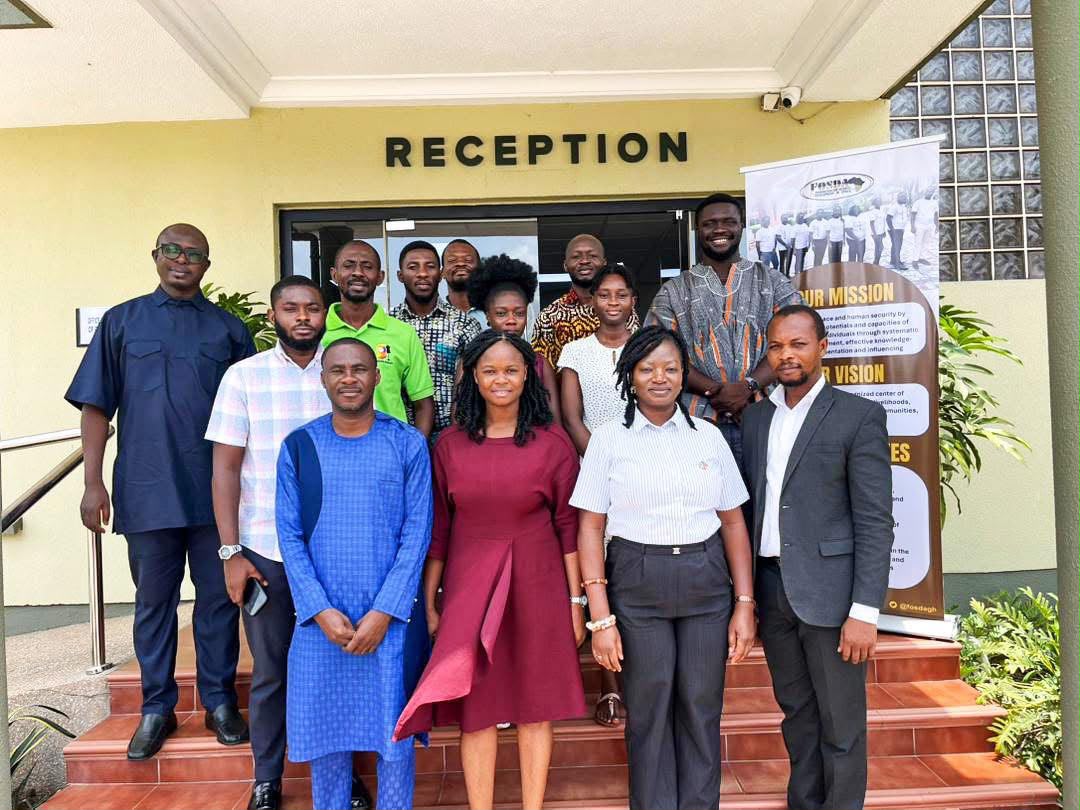
On 14 May 2026, FOSDA convened an advocacy planning and campaign meeting on Technical and Vocational Education and Training (TVET) financing at Sunlodge Hotel, Tesano, bringing together 20 key civil society organisations to push for a more sustainable funding model for skills development in Ghana.
The meeting responded to Ghana’s draft National TVET Policy, which aims to build a dynamic, responsive TVET ecosystem, but is emerging against a backdrop of chronic underfunding, heavy reliance on donors, and the absence of a long-term domestic financing mechanism. CSOs including FOSDA, Eduwatch, SEND Ghana, the CSO Platform on SDGs, Institute for Fiscal Studies, Teria Foundation, Tax Justice Coalition, Imani, and others met to review existing proposals and build consensus on practical options for financing TVET.
Speaking at the opening, FOSDA’s Ag. Programmes Manager, Solomon Okai, underscored TVET’s importance to Ghana’s economy and the urgent need to address financing gaps that undermine quality and access. He highlighted progress made through earlier advocacy with Eduwatch on the Communication Service Tax (CST) as a potential domestic revenue source for TVET and stressed the need for consistent civil society engagement to keep financing on the national agenda.
Presentations from FOSDA and Eduwatch revealed the stark realities of TVET funding. Currently, 123,527 students in 248 schools are served by 11,725 instructors, yet TVET expenditure has averaged under 3% of the education budget over the past 14 years, far below countries like Côte d’Ivoire and Niger at 8% and Uganda at 4%. More than 85% of government TVET spending goes into compensation, leaving very limited funding for practical skills training, estimated at only GHS 33 per student per year, while 33% of TVET graduates report being unemployed. FOSDA’s analysis suggests that adequately financing skills development would require between GHS 81.5 million and GHS 494 million annually, with current funding leaving a gap of 52–92%, partly bridgeable through CST and unspent oil revenues.
Eduwatch reinforced these concerns, estimating that between GHS 4,000 and GHS 9,000 is needed per student to deliver quality training when infrastructure such as workshops, dormitories, kitchens and libraries are properly costed. Their proposals focused on expanding domestic resource mobilisation, including Public-Private Partnerships (PPP), a Skills Development Levy and TVET Endowment Funds, alongside increasing the share of the education budget allocated to TVET.
Group discussions generated concrete options, such as increasing GETFund allocations for TVET from 2% to 10%, exploring the Minerals Development Fund, piloting PTA-led TVET endowment funds, and refining PPP models to include tax-deductible investments and strong corporate social responsibility components. Participants also emphasized the need for holistic financial modelling of the TVET sector, rebranding TVET using platforms like the National Robotics Competition, and tackling stigma among basic school learners to drive demand and, in turn, financing.
FOSDA presented a draft advocacy plan to coordinate CSO actions towards influencing the final TVET policy and ensuring that sustainable financing becomes a central pillar of implementation. The meeting received media coverage, signalling growing public interest in how Ghana can fund practical skills training for its young people.