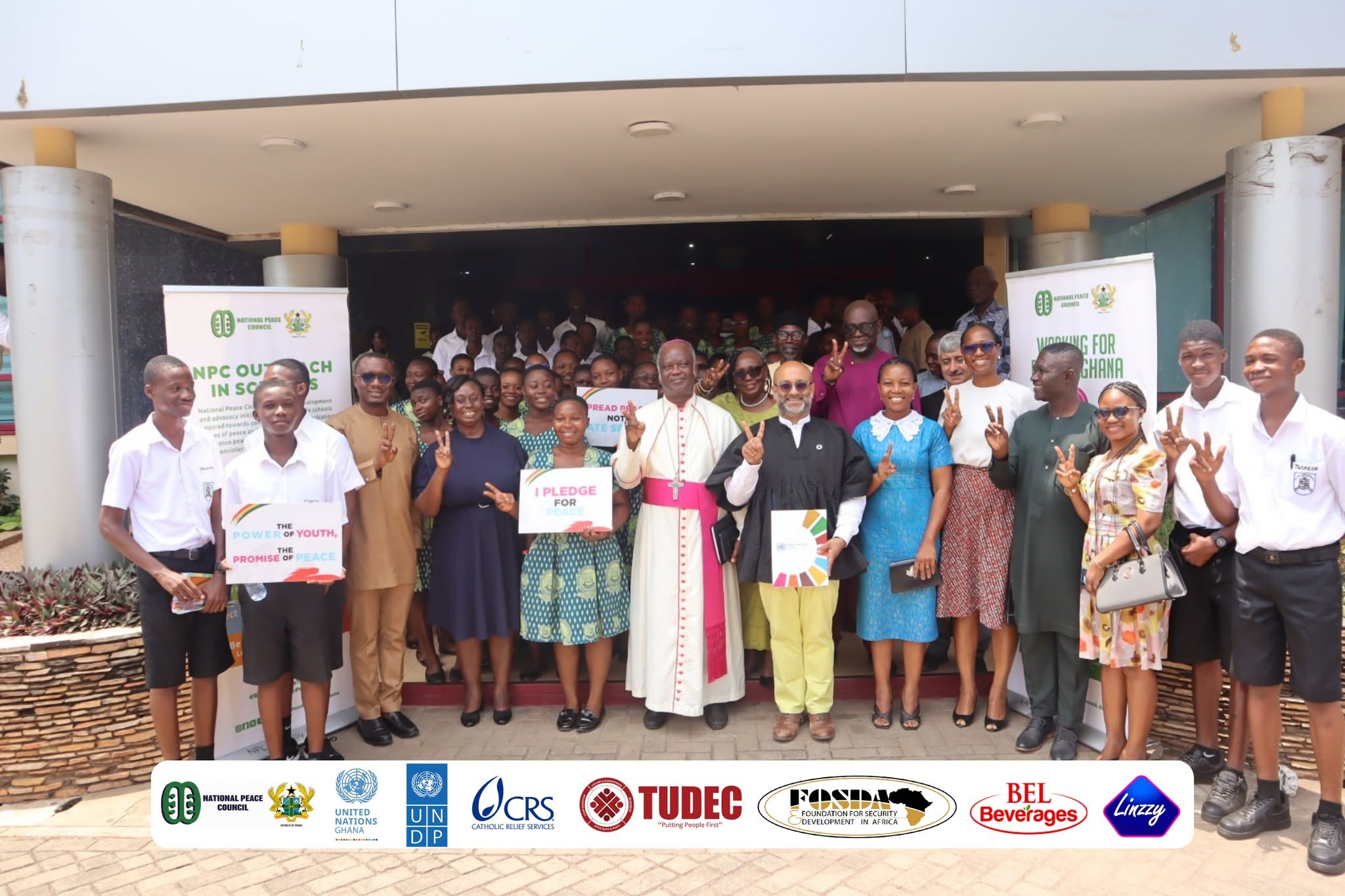
The Foundation for Security and Development in Africa (FOSDA) joined the National Peace Council
(NPC), alongside government institutions, diplomatic missions, development partners, civil society
organisations, youth representatives, students and the media, to commemorate the International Day
of Peace on Monday, 21st September 2026, at the Ghana-India Kofi Annan Centre of Excellence in
ICT, Accra. The event was held under the global theme, “Invest in Peace – For Everyone, Everywhere,
Every Day,” bringing stakeholders together to reaffirm their commitment to peacebuilding and reflect
on practical steps toward peaceful, inclusive and resilient societies.
The event opened with a welcoming address by the Most Rev. Emmanuel Kofi Fianu, Board Chairman
of the National Peace Council, who underscored the shared responsibility of all stakeholders in
advancing peace and social cohesion. Other Council Board members present included Bishop Dr.
Victor Osei, who offered direct counsel to the young people in attendance, and Sheikh Armiyawo
Shaibu, reflecting the interfaith character of the commemoration. Students from various schools were
also present, alongside young people, some between the ages of 8 and 18, trained as conflict agents
within their schools and communities.
The Executive Director of FOSDA, Theodora W. Anti, delivered a message congratulating the National
Peace Council and reflecting on the theme as a reminder that peace requires deliberate commitment
and investment, not chance. She noted that for Ghana, investing in peace means investing in people,
education, healthcare, justice and accountable institutions, and in young people as partners and
leaders rather than mere beneficiaries. She stressed that women and girls must be engaged as
mediators, leaders and decision-makers, and pointed to responsible arms control as central to Ghana’s
security, reminding participants that investment in peace is equally about time, trust, dialogue and
prevention. Drawing on FOSDA’s more than two decades of work with women, youth and
communities, and lessons from localised conflicts such as Bawku and Nkwanta, she called for
investment in people, in women and youth, and in a future where peace is a way of life.
The keynote address was delivered by Mr. Zia Choudhury, UN Resident Coordinator in Ghana, who
challenged participants to move beyond a narrow, financial understanding of peace investment.
Genuine peace, he argued, is built on trust, time and prevention, resources that must be deliberately
cultivated within institutions and relationships, unlike “transactional peace,” which persists only as
long as an incentive remains in place. He identified four priority areas: educators, who shape the
conflict-resolution habits of future generations; health systems, given the link between wellbeing and
social stability; youth, women and girls, engaged as active partners rather than passive beneficiaries;
and responsible arms control, to address weapons proliferation fuelling community and cross-border
violence.
Mr. Choudhury also named developments that threaten Ghana’s peace architecture if left
unaddressed: growing violence in schools, the spread of hate speech, arms proliferation, and a
complacency that mistakes the absence of visible conflict for durable peace. He stressed that interfaith dialogue must be actively strengthened rather than assumed, and set out practical conditions for lasting peace: strong institutions and dialogue that citizens trust; recognising shared humanity before any position on a social issue; protecting shared spaces such as places of worship and learning;
disagreeing without humiliation; and listening before judging. Peace, he reminded participants, is not
the responsibility of the State or the Council alone but belongs to every citizen and institution, who
must resolve disputes without violence and challenge misinformation at every opportunity.
As an organisation working at the intersection of peace, security and youth governance, FOSDA
reaffirms its commitment to translating this year’s reflections into concrete action, strengthening
institutions, safeguarding community spaces, and equipping educators, health actors and young
people as genuine partners in peacebuilding.
Building on the day’s reflections, FOSDA recommend the following
First, government should ring-fence and increase budgetary support for the National Peace Council
and other peacebuilding institutions, treating peace infrastructure as a core national priority.
Second, government should strengthen enforcement of arms control regulations and expand
community-level monitoring to curb the proliferation of small arms.
Third, private sector actors should direct corporate social responsibility resources toward youth
employment, skills development and women-led peacebuilding initiatives, recognising that economic
exclusion drives instability and that a peaceful, stable Ghana is a sound business investment.