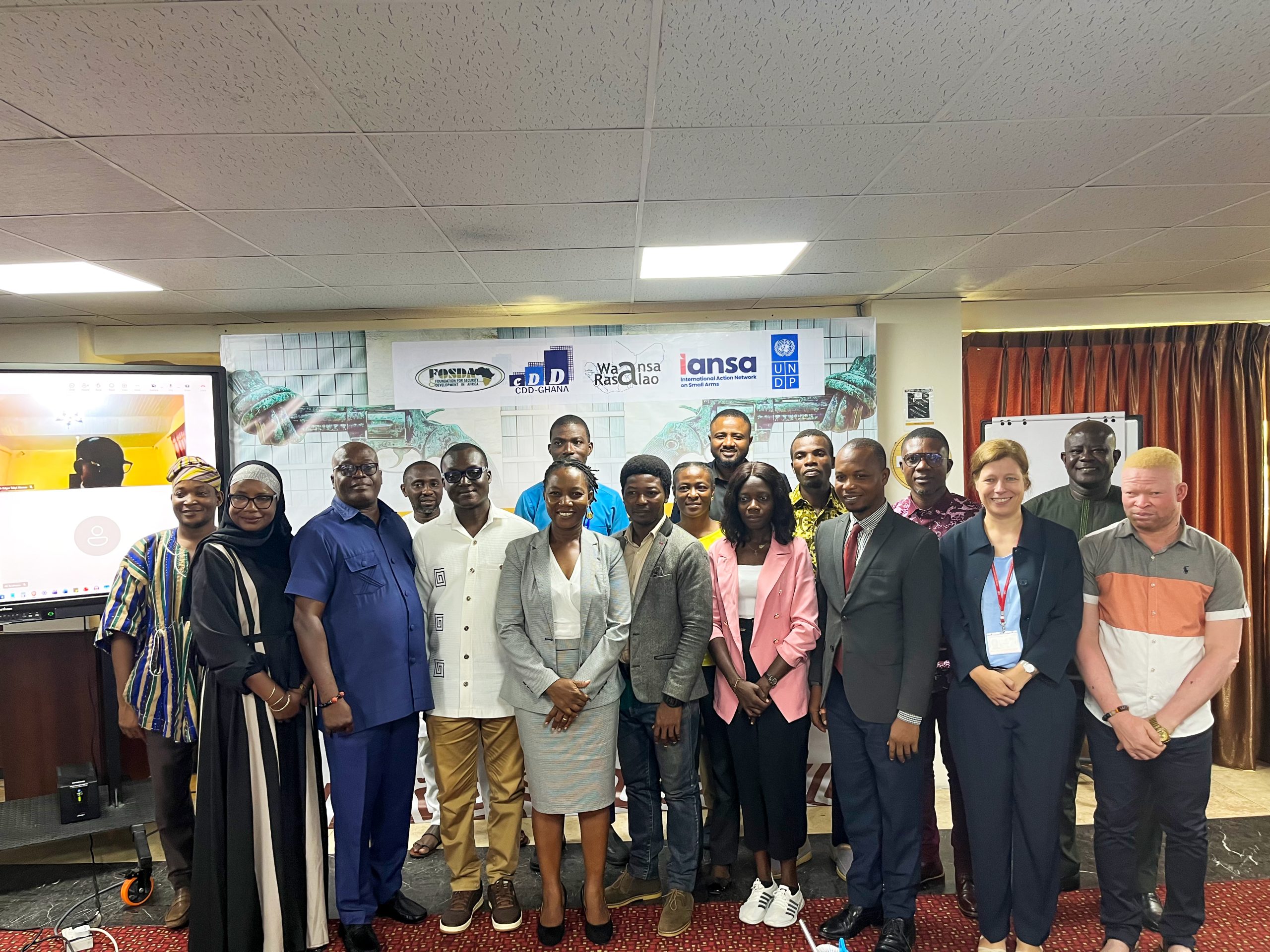
On 26 May 2026, the Foundation for Security and Development in Africa (FOSDA), in partnership with the International Action Network on Small Arms (IANSA) and the United Nations Development Programme (UNDP), convened a high-level Stakeholder Dialogue on the UN Programme of Action (UNPoA) on Small Arms and Light Weapons. Held at the Alisa Hotel in Accra, the forum brought together community advocates, security officials, academic researchers, and international partners for a rigorous and frank assessment of small arms proliferation in Ghana.
The dialogue opened with remarks from FOSDA, IANSA, and UNDP, led by Ms. Theodora W. Anti, Executive Director of FOSDA, who reaffirmed the organisation’s commitment to evidence-based advocacy and urged community-centred implementation of the UNPoA. Mr. Johnson Asante-Twum of IANSA highlighted the cross-border nature of illicit arms flows in West Africa, calling for stronger regional coordination and active civil society engagement. Mr. Leonard Tettey, representing UNDP, linked arms control to broader development priorities, including poverty reduction, gender equality, and resilience, while reaffirming UNDP’s readiness to provide technical and financial support toward achieving peaceful, inclusive, and secure societies.
Ms. Theodora W. Anti opened the substantive discussions with a review of Ghana’s 2025 UNPoA and International Tracing Instrument (ITI) implementation record. While acknowledging progress in legislative harmonisation and stockpile management, she identified persistent gaps, including uneven enforcement across regions, limited community awareness, and the continued circulation of weapons outside formal tracking systems.
Dr. Edgar Takyi Akonor of the University of Cape Coast presented research on emerging trends that are complicating traditional regulatory frameworks, with particular focus on online arms brokering and the role of social media in shaping gun culture among youth. His central argument that digital channels are outpacing policy responses prompted substantial discussion among participants.
Mr. Solomon Okai of FOSDA delivered a compelling civil society perspective on how armed violence is fundamentally reshaping community life across Ghana. Drawing on FOSDA’s own media monitoring data, he noted that the organisation has recorded 549-gun incidents between June 2022 and April 2026, with 2025 marking a sharp peak of 209 incidents the highest in the monitoring period. These figures, he stressed, represent more than statistics; they reflect a deepening crisis in communities where gun violence has become part of daily life.
Mr. Okai highlighted the geographic concentration of the problem, pointing out that the Ashanti Region alone accounts for 118 incidents, more than the combined total of the seven least-affected regions. Greater Accra followed with 79 incidents, underscoring that the threat is not confined to rural or conflict-prone areas but is firmly embedded in urban centres as well.
The human cost, he argued, demands urgent attention. Over the monitoring period, a total of 1,124 casualties were recorded 502 deaths and 622 injuries translating to at least two casualties per gun incident. Among those killed, men represented 60%, while children accounted for 4% of deaths, a figure Mr. Okai described as particularly alarming. He further noted that locally made weapons and pump-action guns the most prevalent firearm type at 47% are widely accessible and circulating well outside formal tracking systems.
Looking ahead, Mr. Okai warned that FOSDA’s forecasting models project between 80- and 150-gun incidents for the remainder of 2026, depending on whether the social, economic, and political conditions driving violence are allowed to persist unchanged. His message was unambiguous: UNPoA implementation is not an abstract policy exercise for thousands of Ghanaians, it is a matter of survival.
Dr. John Pokoo of the Kofi Annan International Peacekeeping Training Centre (KAIPTC) advocated for a systems-level approach encompassing civilian ownership, stockpile diversion, and armed conflict dynamics. Mr. Johnson Asante-Twum of IANSA highlighted how sub-regional illicit arms markets continue to fuel local cycles of violence. Mr. Paul Mensah of the Centre for Democratic Development (CDD-Ghana) drew direct connections between growing firearms demand, climate shocks, land disputes, and the erosion of traditional conflict resolution mechanisms. A representative of the Ghana Police Service addressed the realities of on-the-ground enforcement, while Mr. David Bonsoh of UNDP linked effective arms control to the achievement of Sustainable Development Goal 16 and outlined available financing and technical assistance for committed governments.
The dialogue concluded with key recommendations for government, civil society, and international partners to strengthen small arms control in Ghana. Participants called for a comprehensive review and harmonisation of SALW laws to align with ECOWAS and UNPoA frameworks. They emphasised expanding secondary marking systems to improve traceability of weapons already in circulation. The establishment of a centralised digital national weapons database was proposed to enable real-time tracking and informed policymaking. Additionally, enhancing armoury security and forensic capacity was highlighted to prevent diversion and improve intelligence, alongside increasing public awareness and international cooperation to combat illicit cross-border arms trafficking effectively.
The overarching consensus was unambiguous: Ghana’s arms control framework, sound in design, requires sustained political will, dedicated resources, and genuine multi-stakeholder ownership to translate commitments into tangible results. FOSDA reaffirmed its commitment to advancing this agenda through continued advocacy, community engagement, and evidence-based policy development keeping the security of ordinary Ghanaians at the centre of all efforts.