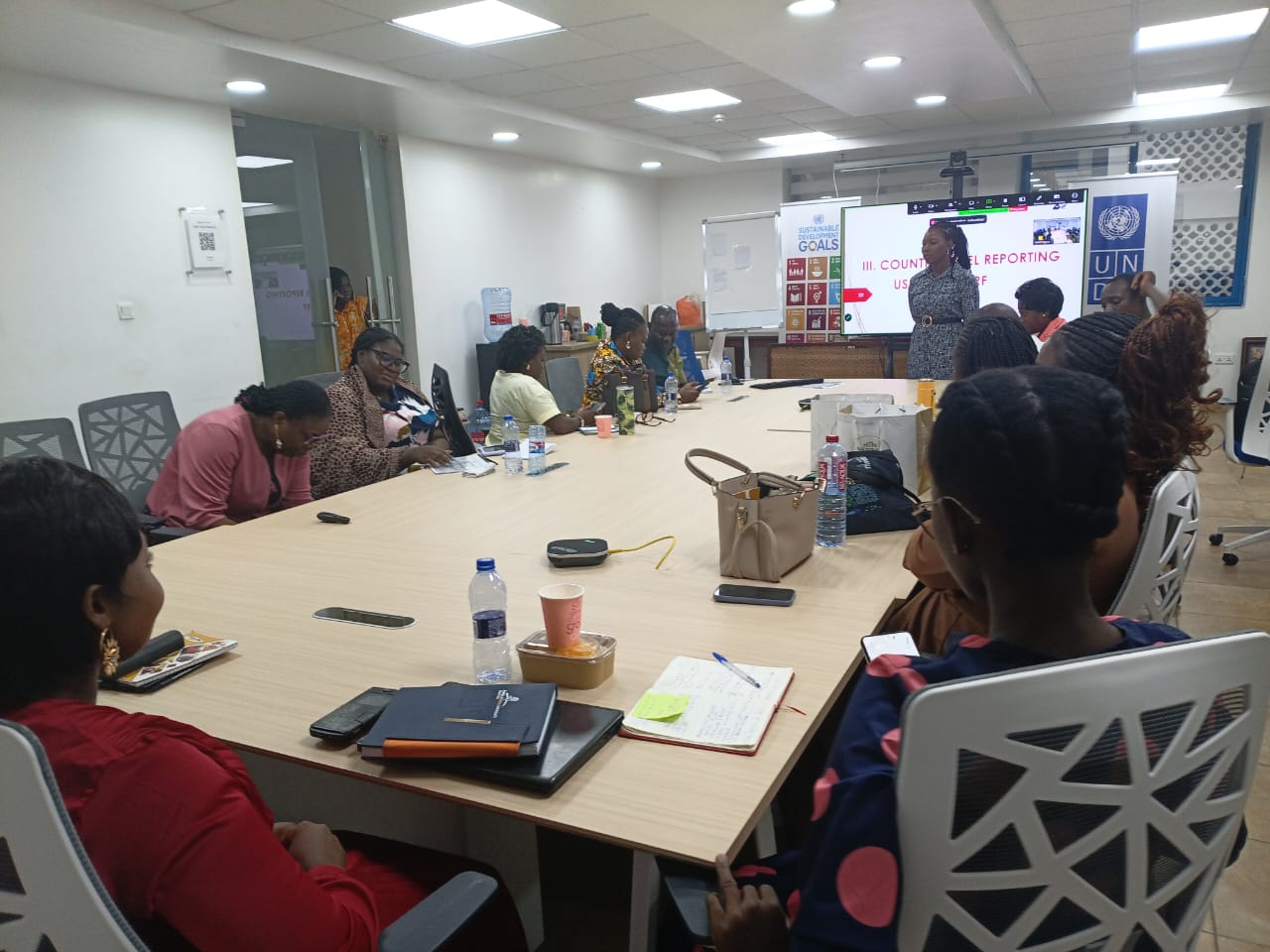
The Foundation for Security and Development in Africa (FOSDA) has successfully co-hosted a crucial two-day advocacy and capacity-building programme on the African Union Continental Results Framework (AU-CRF) for tracking United Nations Security Council Resolution (UNSCR) 1325. Organized in close partnership with the UNDP, the Women, Youth, Peace and Security Institute (WYPSI) of the Kofi Annan International Peacekeeping Training Centre (KAIPTC), and UNOWAS, the training directly empowered members of the Ghana Chapter of the UNOWAS Working Group on Women, Youth, Peace and Security (WGWYPS) and key civil society networks including NOPSWECO, ROAJELF, WOMNET, NETRIGHT, and WILDAF.
The workshop was held on the 21st and 22nd of May 2026 at the UNDP premises.
As a leading civil society voice monitoring the Women, Peace, and Security (WPS) agenda in Ghana, FOSDA played a central technical role in the training by bridging empirical monitoring data with future accountability. Drawing directly from FOSDA’s Phase 1 and Phase 2 independent monitoring reports of the Ghana National Action Plan (GHANAP 2), Ms. Dorothy Barnes, FOSDA’s WPS Project Coordinator, delivered a core presentation titled “Introduction to the National Action Plan implementation and challenges and success stories.”
Through this session, she educated participants on the first and second generations of the Ghana National Action Plan on UNSCR 1325 and the broader WPS agenda. The presentation showcased how FOSDA’s monitoring lens highlighted significant national breakthroughs, such as the major increase in stakeholder awareness of the GHANAP, the landmark formal adoption of gender policies by security services like the Ghana Armed Forces (GAF), and the gender parity being achieved in some security services recruitment. Concurrently, FOSDA presented a clear-eyed look at ongoing implementation bottlenecks, including the chronic absence of a ring-fenced state budget line and critical infrastructure deficits for rehabilitation shelters at the district level.
Crucially, Ms. Barnes leveraged the data she presented to also make a compelling justification for the training’s core objective: the adoption of the AU Continental Results Framework. She demonstrated to participants how transitioning to a standardized continental tool naturally complements and structures national monitoring. By utilizing the unified indicators of the AU-CRF, all stakeholders will be better positioned to seamlessly document local breakthrough success stories while mapping and addressing operational challenges using a shared, regional language.
With GHANAP 2 having reached its conclusion, the workshop also served as a strategic platform to deliberate on the critical transition forward. Equipped with the data provided by FOSDA’s tracking, participants unitedly urged active support for the Ministry of Gender, Children and Social Protection (MoGCSP) in drafting and institutionalizing an agile, sustainably funded third-generation National Action Plan (GHANAP 3), where all stakeholders collectively support monitoring efforts through regular data sharing. Through this training, FOSDA has reaffirmed its commitment to ensuring that Ghana’s unique WPS journey is not only accurately captured at the grassroots level but powerfully integrated into the wider African Union accountability architecture.